What Was the Main Art Style in the Early 1800s?
Cooking in the 1800s
Originally published as "When Dinner Wasn't Quick and Like shooting fish in a barrel"
By Courtney Hybarger
Reprinted with permission from Tar Heel Inferior Historian, Spring 2007.
Tar Heel Junior Historian Association, NC Museum of History
 Mind to this entry
Download MP3 audio
 Today'southward rapidly increasing demands and hectic schedules brand it challenging for a family to dine together. Many dinners include fast food or carryout delivery from places like KFC or McDonald's. When families do accept fourth dimension to prepare a meal, it is rarely "from scratch." Applied science that we often take for granted—such as microwaves and refrigerators—has greatly affected what we swallow and how we eat it.
Modern meals are planned around the family's schedule, but this was not the example two hundred years ago. In fact, two hundred years ago, the family planned its schedule effectually meals!
During the early on 1800s, cooking dominated the time and energy of the average housewife. There were no large grocery stores where families could go to purchase nutrient, and eating out was truly a rare treat, usually possible only when traveling. Almost fruits and vegetables were grown on the farmstead, and families processed meats such as poultry, beef, and pork. People had seasonal diets. In the spring and summer months, they ate many more fruits and vegetables than they did in the fall and winter. During those colder seasons, families found means to preserve their food.
The three main ways of curing (the procedure of preserving food) during this fourth dimension included drying, smoking, and salting. Each method drew moisture out of foods to prevent spoiling. Fruits and vegetables could be dried by beingness placed out in the sun or near a estrus source. Meat products could be preserved through salting or smoking. A common salt cure involved rubbing table salt into the meat, which was then completely covered in salt and placed in a cool area for at least twenty-eight days. During this fourth dimension, more common salt was constantly added. When the meat was no longer clammy, it was washed, and then shelved or bagged and left to age. Families would hang meat preserved through a smoke cure in rooms or buildings with fire pits. For a calendar month, the meat was constantly exposed to fume, which dried information technology out while adding flavour. Using different kinds of wood for the fire, such as hickory or oak, could produce different tastes.
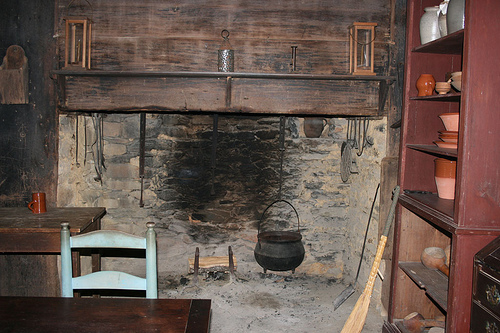
A typical day on the subcontract began very early. Women rose and built the fire based on the meals planned for that solar day. Families who could beget to have discrete kitchens—kitchens in buildings separate from the business firm—did so for several reasons. The kitchen often was hot, smoky, and evil-smelling. Well-nigh N Carolina families did not have the resource for a separate kitchen, though, and the hearth provided the heart of dwelling house life and family unit action. With no ovens or electricity, women prepared meals on the hearths of brick fireplaces. They used different types of fires and flames to ready different types of food. For example, a controllable burn down was used to roast and toast, while humid and stewing required a smaller flame.
To employ all of the fire's energy, families shoveled coals and ash underneath and onto the lids of Dutch ovens. Continuing on three legs and available in a wide array of sizes, the cast-iron Dutch oven was one of the most important tools found on the hearth. It was used to fix several types of nutrient and allowed cooking from both the top and the bottom. Dutch ovens evolved into woodstoves, common in homes of the later 1800s and early 1900s earlier nearly people got electricity at abode.
Preparing meals was not merely a matter of starting a fire for cooking. Spices, such equally nutmeg and cinnamon, and seasonings, like salt and pepper, had to be ground upward with mortars and pestles. Milk had to exist brought in from the family dairy cow and cream and butter fabricated from it. Later someone brought in the milk, it usually sat out for about an hour. The cream rose to the acme, separating from the milk. Women placed this foam into a butter churn and beat information technology until information technology hardened, showtime into whipped cream and eventually into butter!
Every family unit member contributed to the product and preparation of meals. Men and boys spent nearly of their time outdoors. Chores included working crops in the fields, feeding larger livestock, and hunting. Diets included wild game, such as deer and turkeys. Women and girls worked mainly in the kitchen and fed smaller livestock.
When it came time to butcher animals, families joined with their neighbors to share the workload and the meat. Pork was the staple meat in the Southeast until the 1940s. Hogs proved more manageable than their much larger counterparts, cows. The taste of pork likewise improved with curing. Neighbors often gathered in the fall, using the time to get their piece of work done merely also to catch up, sharing news and gossip. What began as a chore turned into a social event. This was also the instance at harvesttime. Neighbors pitched in to bring in crops such as corn and wheat. After the work was done, anybody might celebrate with feasts, bonfires, and dancing.
Conspicuously, meal preparation ii hundred years ago involved several more steps than it does at present. Much like today, families usually ate three daily meals. The primary repast in the 1800s, however, was not the large evening repast that is familiar to u.s. today. Rather, information technology was a meal called dinner, enjoyed in the early afternoon. Supper was a smaller repast eaten in the evening.
A big departure between the way people eat today compared with long agone is the work and fourth dimension needed. For modernistic families, food and meals are merely an afterthought in the schedule. Two hundred years ago, nutrient and food preparation stood at the middle of the family unit'southward daily lifestyle. Without the advances in engineering science that help us store, preserve, and prepare food, men and women would spend much of their time getting meals set up to consume. Instead of calling pizza delivery, imagine spending all twenty-four hour period in front of a fire!
At the time of this commodity's publication, Courtney Hybarger was a celebrated site interpreter at President James K. Polk State Historic Site in Pineville.
Source: https://www.ncpedia.org/culture/food/cooking-in-the-1800s

Post a Comment for "What Was the Main Art Style in the Early 1800s?"